heiter magazine

inspiring you to live & style your life so that it feels good

  • SHOP
    • ALL
    • MAGAZINE
    • EVENTS
    • COMMUNITY
    • RESOURCES
  • BLOG
    • LATEST POSTS
    • DAILY JOY
    • FASHION
    • LIVING
    • RECIPES
    • TRAVEL
    • INTERVIEWS
    • PARENTING
    • BUSINESS
    • DIY
  • MEMBERSHIP
  • EVENTS
  • ABOUT

Recipes & images by Elisabeth Grindmayer

Blooming into the new year: two alcohol-free drinks recipes you will love

January 20, 2026 by Katharina Geissler-Evans in Heiter recipes, Well-being

Each year heiter contributor Elisabeth Grindmayer makes the conscious decision to skip alcohol in January. Sometimes she goes on even longer and extends her alcohol-free weeks to February and March. She doesn’t see her tradition as a form of deprivation. To her it’s a little detox after the holidays and an opportunity to let both body and mind bloom again.​ It helps her clear her thoughts, regain energy and have clarity for new ideas. January is her month to plant seeds that can grow and eventually blossom in summer.

Discover two of Elisabeth’s latest alcohol-free drinks recipes. She used them with Aronia as base. You can read more about the superfood and its health benefits below.


Elisabeth Grindmayer_ Tonic Marigold-4123_websize.jpg
Elisabeth Grindmayer_ Tonic Marigold-4135_websize.jpg

Blooming Aronia Tonic

A refreshing “virgin aperitif”. The bitter notes of tonic beautifully balance the tannins of Aronia and create a combination that is ideal to be enjoyed with goat cheese or fried appetizers. My tipp: choose Tonic water that is not too sweet and more dry in taste. 

I believe that an alcohol-free drink should look good too, so before serving I slightly dipped the rim of the glass in honey and then in dried flowers that I had collected from the kitchen garden last summer.  I always store various edible flowers in jars –– calendula/marigold, cornflowers, chamomile, rose petals, to name a few. I love sprinkling them over salads like confetti, or using them as a garnish for drinks and you know what? It never fails to make me feel "heiter"! For this drink, calendula and its warm yellow brings a lovely glow and creates a nice contrast to the deep red tone of the drink.

Ingredients:

60ml Aronia juice

120ml tonic water

15ml fresh lemon juice

Large ice cube

Garnish: a little bit of runny honey and dried edible flowers (here: calendula/marigold)

Preparation:

Place some of the honey on a small plate and a few dried edible flowers on a second plate. Briefly dip the rim of the glass in the honey, then in the dried flowers so that they stick. Fill the glass with ice cubes.

Pour the Aronia juice and lemon juice in the glass and stir. Top up with dry tonic water. Done.

Elisabeth Grindmayer_ Black Tea Aronia Highball-4159_websize.jpg
Elisabeth Grindmayer_ Black Tea Aronia Highball-4208_websize.jpg

Black Tea Aronia Highball

Simple, but with depth. The tannins and malty notes of the black tea and the tart Aronia: the result is an aromatic drink that almost resembles a dry red wine. It pairs wonderfully with hearty dishes like roasts, braised vegetables, or mushrooms.

Ingredients:

50ml Aronia juice

100ml strong, cooled black tea e.g. Assam

10ml lemon juice

Optional: 5ml maple syrup

Ice cubes

Garnish: lemon zest

Preparation:

Fill a highball glass with the ice cubes.

Mix the cooled black tea, Aronia juice, and lemon juice; shake or stir well. If you’d like, add the maple syrup. Personally, I prefer my drink to be not too sweet, so I skip it. Fill the glass with the drink and garnish it with the lemon zest. Enjoy!


Good to know: Aronia is a true powerhouse. In Elisabeth’s native Germany and her chosen home Sweden, it's an old cultivated plant: undemanding, frost-resistant, and wonderfully adapted to cooler climates.

Aronia is rich in antioxidants and polyphenols that protect cells and have anti-inflammatory effects. Especially during the wet and colder months of the year, Aronia is the perfect booster for your immune system. Elisabeth explains that we don’t necessarily need far-traveled superfoods like Goji or Açaí berries when Aronia practically grows on our doorsteps. Pure Aronia juice is available in the form of juice and powder at many health food stores and organic shops these days. The taste is tart, slightly sour, and tannin-rich – a great base for alcohol-free drinks.​


Munich-born Elisabeth Grindmayer lives on an 100-year-old forest farm in the wild nature of Southern Sweden. She works as freelance photographer and author (for magazines, publishers, and brands), primarily in the areas of food, kitchen gardening and slow living. With the help of the recipes and stories of her cookbooks “Ein Jahr in Schweden" (Hölker Verlag 2024) and “Weihnachten in Schweden” (Hölker Verlag 2025), she takes her readers on a culinary and visual journey to her newly chosen Swedish home. Learn more about here here: elisabethgrindmayer.com

January 20, 2026 /Katharina Geissler-Evans
alcohol-free drinks, hosting, cocktails
Heiter recipes, Well-being
Comment

Images by Richard Gaston

La Casita: a colourful, considered home for glass artist Juli Bolaños-Durman

December 10, 2025 by Katharina Geissler-Evans in Living, Brands & creatives

“Homecoming” can have different shapes and forms. This is also something Costa Rican glass artist Juli Bolaños-Durman explored when creating La Casita—“the wee house”, her new home and creative anchor. Designed in close collaboration with Architecture Office, the Edinburgh-based project brings together colour, curiosity, and conscious making, resulting in a space that feels both deeply personal and quietly radical in its approach to reuse.

Juli

Known for transforming discarded glass into joyful, sculptural pieces, Juli approaches her work with a sense of care for the overlooked and a fascination with imperfection. That same philosophy runs throughout La Casita. Every room is shaped by resourcefulness—materials reclaimed, repurposed, and given new life—while still honouring the character of the Victorian building beneath.

Architecture Office, led by Alexander Mackison, embraced this ethos from the outset. Rather than imposing a fixed aesthetic, the design evolved through a “material-first” process, letting found objects, offcuts, and reclaimed elements guide decisions. The result is a home that feels intuitive and lived-in, crafted through collaboration with local makers who share the same reverence for craft.

The kitchen

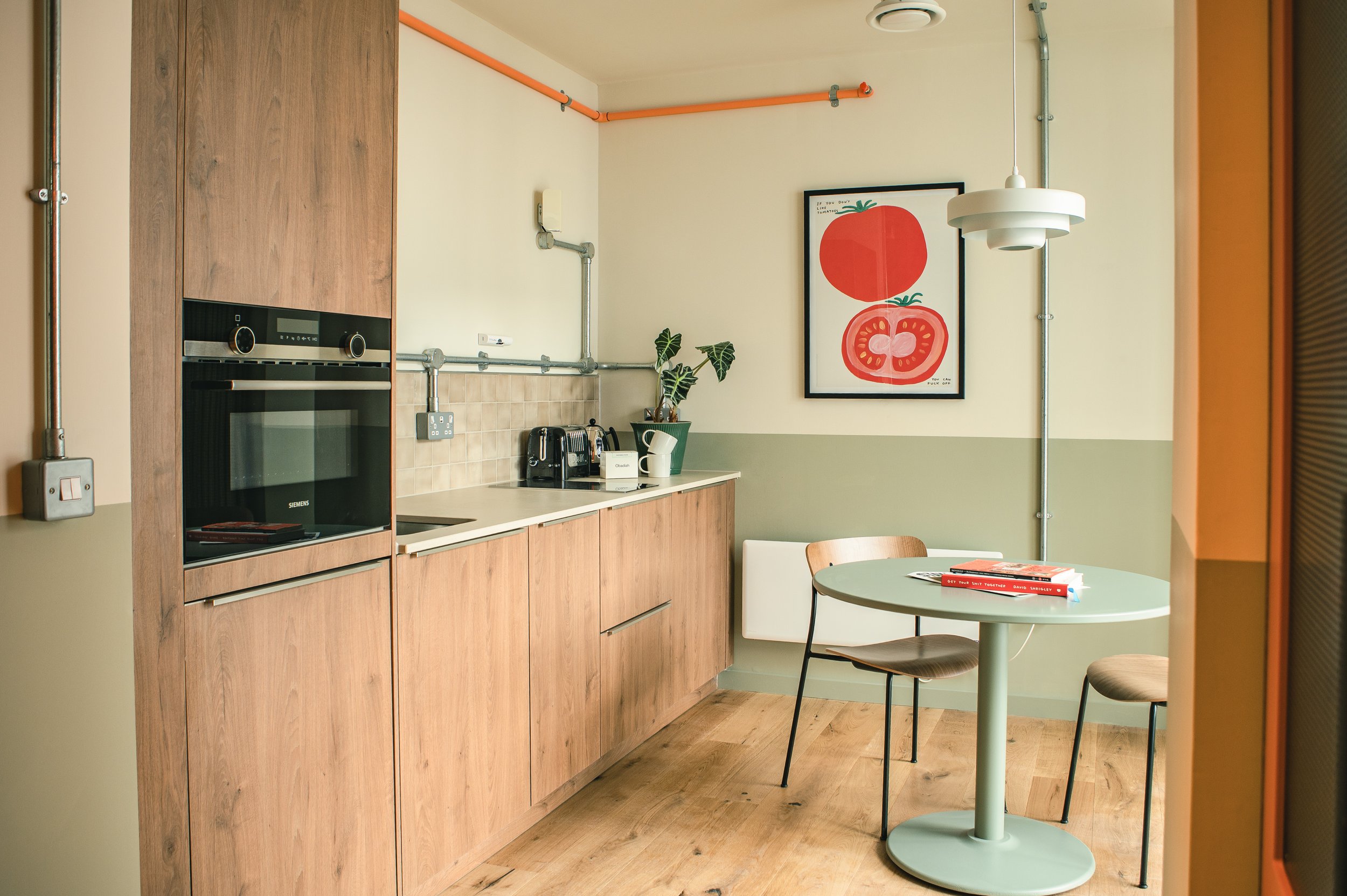
At the heart of the flat sits a bespoke kitchen built by Studio Silvan almost entirely from surplus timber. A gradient of Brown Oak, Oak, Cherry, Douglas Fir, and Ash forms a gentle patchwork—each species celebrated for its natural tone and texture. Even the internal carcasses are formed from repurposed Valchromat, revealing flashes of colour behind the refined fronts. It’s a space that feels warm and tactile, a quiet celebration of sustainable Scottish craftsmanship.

Stone, too, plays a playful role. Offcuts supplied by Britannicus Stone—Frosterley, Ledmore, Swaledale Fossil and Stoneycombe—have been arranged according to the sizes they arrived in, creating a joyful, almost puzzle-like surface language across the home. In the living room, a forgotten firebox led to the creation of a sculptural mantelpiece: three rescued slabs from local mason AB Mearns, assembled into a monolithic, almost totemic form. With raw edges intentionally left exposed, the fireplace becomes a grounding point—a moment of honesty within the room.

The living room

The palette stays gentle. Walls painted in Little Greene’s Re:mix range provide a soft background that lets Juli’s vibrant objects shine. But there are bursts of joy, too: a corridor painted a striking, sunny yellow, inspired by the Cortez Amarillo tree from Juli’s hometown. It casts warmth into the surrounding rooms, softening the Victorian bones and anchoring the space with a sense of home.

The hallway

The bedroom

True to Juli’s practice, La Casita is also a living gallery—a place where her collected treasures, from glassware to ceramics, can be arranged and rearranged. As she describes it, “These everyday items surround and inspire me, each one a beautifully humble moment.”

More than a renovation, La Casita is a conversation—between artist, architect, and the community of makers who contributed. It’s a reminder that originality doesn’t need to come from newness. Beauty can be coaxed from what’s already around us, waiting to be noticed. Architecture Office’s Alexander Mackison reflects this spirit well: “The project became an exercise in composition and balance… allowing the materials to speak for themselves.”

In its quiet, joyful way, La Casita poses a gentle challenge: to look again at what we discard, to value local surplus, and to open ourselves to the possibilities in reuse. It’s a home shaped with compassion and ingenuity—a small, bright example of how thoughtful design can nurture both the everyday and the extraordinary.

December 10, 2025 /Katharina Geissler-Evans
edinburgh architecture, scotland art, glass art, creative women
Living, Brands & creatives
Comment
  • Newer
  • Older
 

FEATURES & PRESS MEDIA KIT WORK WITH US STOCKISTS

© 2025 heiter magazine. All rights reserved.

Impressum | Imprint Delivery & Returns Privacy Policy